Yep, our negative life experiences accumulate, and leave deep traces.
My sense (having visited Chile often, speaking Spanish, having Chilean friends and cousins – including politicians) is that Chile lacks the two bases on which the “Nordic model” rests: ethnic and social homogeneity (before the recent waves of Third-World immigration began to sink Scandinavia) and evangelical Christianity (“Protestant work ethic”, etc.). There’ve been attempts since the early nineteenth century to free the country from Roman Catholic fatalism, and attempts to deny political power to various ethnic and social groups, all with the intent of constituting what would be a very different country. As matters stand now, all such attempts seem foredoomed.
“mem”, the vertical division in the population graphs is for sex, not for political preference.
Are we blessed by the presence of the very same RWS who disappeared from the former board long-long-long time ago?..
~LF (formerly “rune”)
Who else would post as RWS?
Welcome back, I bet you are surprised many of us lasted this long and are still here in Chilezuela.

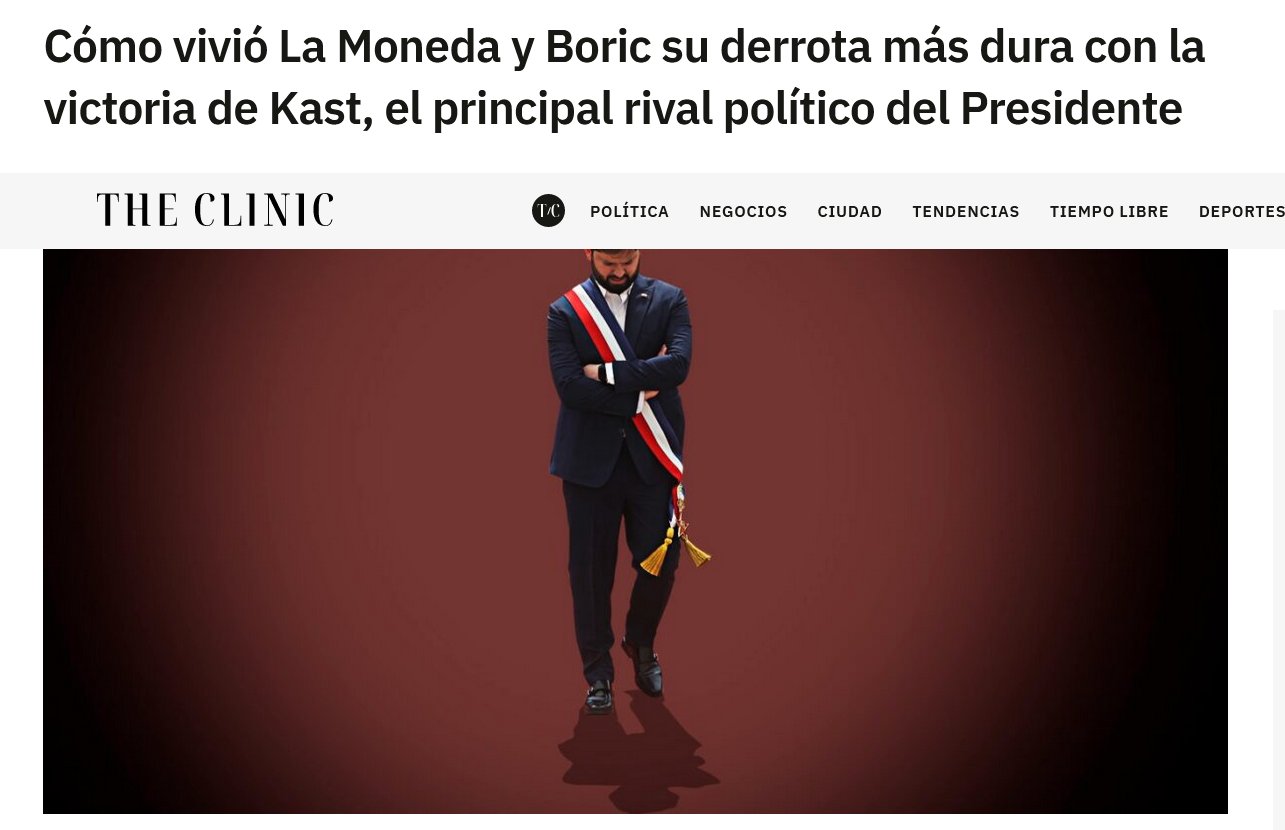
Good riddance to bad rubbish - finally.
All I can say that the majority here on this forum (supporters of populist conservatism) were correct about Boric’s admin and then some.
And analyzing the two Presidential elections, IF this election had been voluntary like the 2021 election, the commies could have pulled off a 50% plus 1 or more win where I would already be working on an expatriation plan (at least for assets) to somewhere else.
Compulsory voting is what has saved Chile from the highway to commie hell. We saw it with the “Rechazo”, the 2nd constitutional convention delegate and yesterday’s Presidential elections. Mandatory voting forces the Chilean “silent majority” to the polls and they overwhelmingly lean popular right.
The officialist parliamentary initiative to restore the voluntary vote, or at least to eliminate the fine for non-compliance shows they realized that possibility.
For the same reason they attempted to restrict the effects of the resident foreigner vote by increasing eligibility requirements to 10 years residence.
But they failed.
I have a question on this as I don’t know the history. That law was passed during Boric’s term. Why did they pass it given that it was obviously detrimental to them? Or is this one of those things that started years ago that finally ground its way through Congress and the Senate before he arrived and he begrudgingly signed it?
Don’t have the answer to that one, maybe feargle? Or perhaps the left felt they really did have a mandate from the People and got cocky after the voluntary Boric and the first Constitutional Convention wins and somehow felt returning to compulsory voting wouldn’t harm them. And after they got spanked in the next elections, they somehow could not muster the support to return to voluntary voting. The best laid plans of commie mice and commie men…
1 Like
Honestly, I support the 10 year residency requirement even though it would temporarily disadvantage me.
The Forum Search found my own post. The initial aim was to restrict Resident voting to local and municipal elections only. That didn’t fly for legal reasons, so later on they faffed about with the idea of eliminating the penalty for non compliance.
That would have virtually transformed the Resident vote into a voluntary one, but that parliamentary initiative seems to have fizzled out as well. Anyhow it was too little, too late to save them.
The Resident sentiment is clearly anti-leftwing so the idea was to discourage them from voting by removing the fine. That’s the cheap mentality of (some) Chilean politicians.
Thanks, but I think we’re talking about different things. I’m not talking about them trying to pass a law to suppress resident turnout. I’m talking about the law which made voting compulsory for EVERYONE, which would force mainly right-wing non-voters (whether citizens or residents) to vote and boost the right-wing turnout.
The only logical source of such a proyecto de ley would be a right-wing government. So, the only way I can think this happened was that Pinera’s government saw that non-voters were mainly right-wing, brought a proyecto de ley to Congress and got it passed and Boric had no choice but to sign it into law when he took office. On the other hand, if it was brought by Apruebo Dignidad, it’s a stupendous own goal.
OK, I asked ChatGPT so interpret with caution…
The law to reintroduce mandatory voting was Law 21.533 and apparently had bipartisan support.
Apruebo Dignidad supported the bill, but with internal nuance and some reservations, especially on sanctions rather than on the principle of mandatory voting itself.
Here is the precise picture.
Short answer
Apruebo Dignidad (FA + PC) voted in favour of restoring mandatory voting.
Their support was not reluctant, but it was conditional and qualified.
The main point of tension was how non-voting would be sanctioned, not whether voting should be mandatory.
How Apruebo Dignidad positioned itself
1. Support in principle
Both components of Apruebo Dignidad:
Frente Amplio
Partido Comunista
had, by 2022–2023, largely converged on the view that:
voluntary voting had failed in Chile,
low turnout was socially biased (younger and poorer voters abstained more),
democratic legitimacy — especially for constitutional processes — required high participation.
This was reinforced by:
the 2022 plebiscite, where mandatory voting produced ~85% turnout,
evidence that voluntary voting distorted representation.
As a result, Apruebo Dignidad backed reinstating compulsory voting.
2. Where the reservations were
The disagreements inside Apruebo Dignidad focused on:
- sanctions, not obligation.
Specifically:
FA and PC legislators argued against criminal penalties or harsh fines.
They pushed for:
low, proportional fines,
broad justifications/exemptions,
administrative (not penal) enforcement,
protections for vulnerable groups.
This put them closer to the Uruguay / Australia model than to a punitive one.
3. Voting record
In the key votes on the constitutional reform that became Law 21.533:
Apruebo Dignidad parliamentarians voted overwhelmingly in favour.
There was no coordinated opposition from the bloc.
Any abstentions or critical speeches were about implementation, not rejection.
Notably:
- Leaders from FA and PC publicly framed mandatory voting as a collective civic duty, not as coercion.
Why this matters politically
This position represents an evolution, especially for the Frente Amplio:
In the 2010s, parts of FA were sympathetic to voluntary voting.
By 2022, experience showed voluntary voting:
weakened popular participation,
advantaged organised minorities,
undermined constitutional legitimacy.
So Apruebo Dignidad’s support reflects learning from institutional outcomes, not ideological inconsistency.
So, it seems that both sides thought that they would benefit by reintroducing mandatory voting, but Apruebo Dignidad overestimated the number of young people supporting them.
The obligatory vote was re-established in 2022 with virtually unanimous support by legislators, concerned by ever-decreasing voter participation under the voluntary system.
A case in point was the 2019 plebiscite, where the voter turnout was only 51%. Of that number, 78% voted in favour of establishing a Constituent Assembly. Putting it another way, only 40% of the electorate initiated the process of establishing a radical New Constitution.
Fortunately the resultant pig’s ear, the “mamarracho constituciónal” was firmly rejected by the voters in 2022
A synopsis here from 2022:
Santiago, Chile, Dec 19 (EFE) – The Chilean Congress on Monday approved the reinstatement of mandatory voting for elections and referendums, a requirement the country had abandoned in 2012. The decision, passed by a cross-party vote, saw the legislature reinstate the requirement.
By a vote of 124 in favor, 6 against, and 3 abstentions, the Chamber of Deputies approved the constitutional reform that establishes mandatory voting in all elections except primaries. The reform also stipulates that fines and penalties for non-compliance, as well as the list of voters exempt from voting, will be determined by an organic law.
What has happened since then is pure electoral tinkering - shitty attempts to gain unfair advantage at the polls by limiting participation. Bachelet had attempted something similar on a smaller scale by allowing nonresident Chilean nationals to vote abroad, knowing full well that countries like Sweden, Demark and Australia had sizeable numbers of commie refugiados.
I believe the RECHAZO vote (of the far far left wokester drafted constitution) took place near the end of 2023 with compulsory voting back in place.
Yeah, 2023.
That vote marked the beginning of the end for Boric & Co.
It seems that some of you you think that mandatory voting favoured Kast rather than Jara, or right rather than left. What is the evidence for this?
I think Kast in 2021 was perceived as the more extreme candidate but in 2025 he might have been perceived as the less extreme candidate.(in a very simple way: one is communist, the other isn’t). I think the late deciding, apolitical voters may turn out for the less extreme candidate rather than for right or left, but I’m really speculating, no evidence. I think these voters could lean Parisi next time: again speculation.
Constitutional Convention vote - voluntary.
2021 Presidential election vote - voluntary.
Then followed by some of the biggest spankings in the left’s history.
Rechazo - compulsory.
2nd Constitutional Convention swept by “extremist” Republicans - compulsory.
The vote (compulsory) for the second constitution could have passed if the right didn’t split (Chile Fuimos uniting with the further to the right of Kast to form a strange right anti-Kast coalition) but it did preserve the Pino founded constitution and put an end to more far left inspired constitution projects.
Then there was the less exciting muni election - compulsory, where the independent candidate vote equaled the percentage of the respective right and left blocks. My take on this is that this would have been a normal more than 50% sweep by the left if it wasn’t for compulsory voting.
And finally the 2025 Pres election ground-shaking Kast win where as described on this board, the left tried to return to voluntary voting or exclude voters they perceived as detrimental.